Friday, January 15, 2010
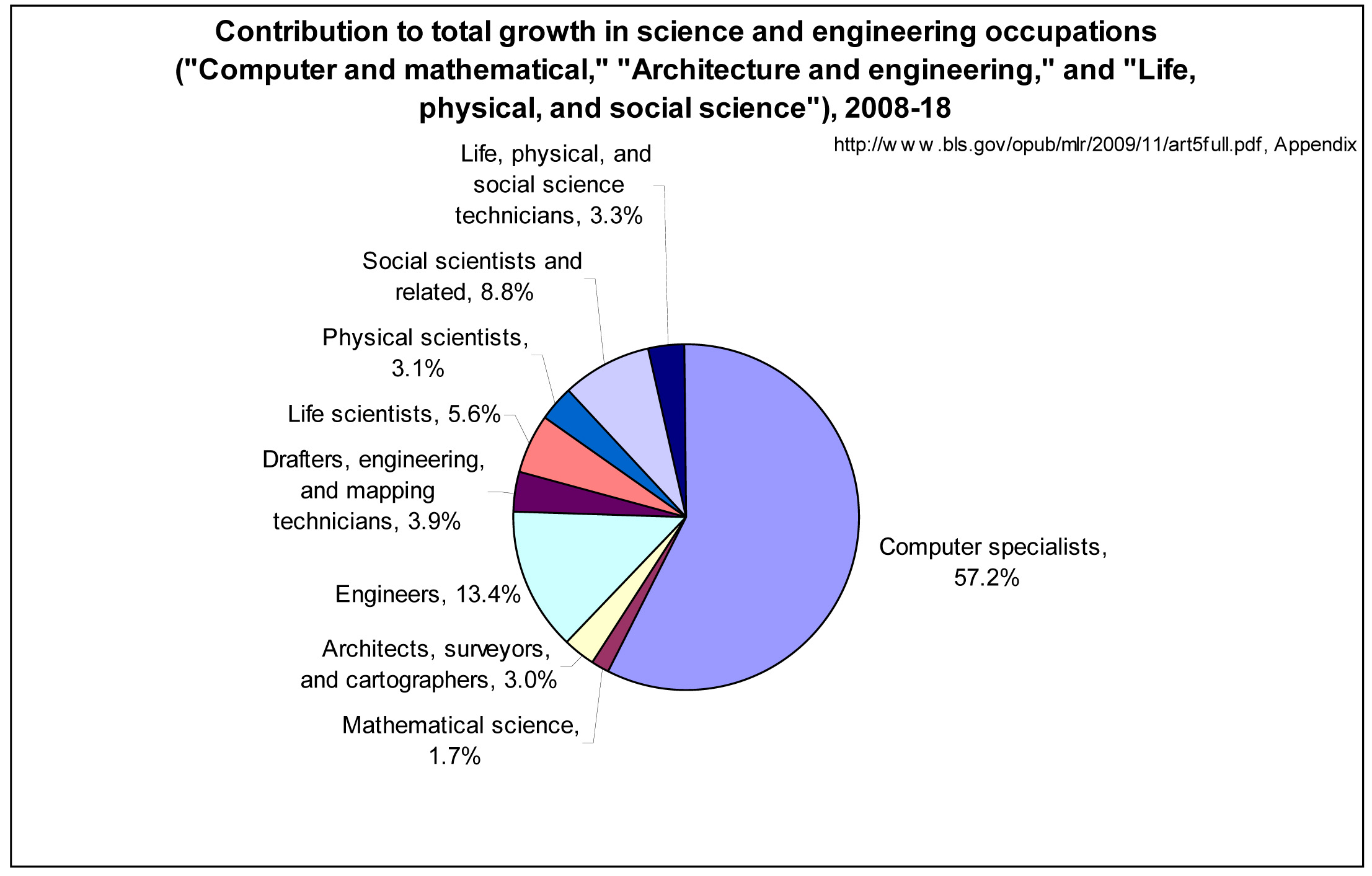
Computer and Mathematical occupations among fastest growing

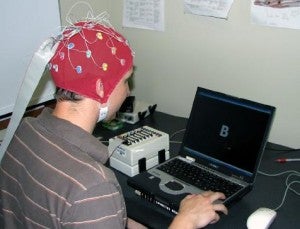
Reading Your Mind to Tag Images
Development of real-life Avatars

During its regular assembly held on Friday, the Robot Convergence Forum expected that the avatar robots would hit the market in a few years. The forum involves both the private and public sectors.
"Already, domestic robot makers are working on prototypes of avatar robots and the consensus is that the commercial versions will come to town by late 2013,'' a Ministry of Knowledge Economy (MKE) director said."
Wednesday, January 13, 2010
Social science meets computer science at Yahoo
Social science meets computer science at Yahoo: "Shortly after Carol Bartz took over as chief executive of Yahoo Inc. early last year, she met with Prabhakar Raghavan for an overview of the Sunnyvale Web giant's research division. As the head of Yahoo Labs ran through the catalog of computer scientists on staff, Bartz turned to him and asked: 'Where are your psychologists?'"
"Raghavan was stunned the newly installed CEO had so quickly gotten to a question he'd been asking for years. His answer was they didn't have enough.
That's changing. In the last year, Yahoo Labs has bolstered its ranks of social scientists, adding highly credentialed cognitive psychologists, economists and ethnographers from top universities around the world. At approximately 25 people, it's still the smallest group within the research division, but one of the fastest growing.
"Raghavan was stunned the newly installed CEO had so quickly gotten to a question he'd been asking for years. His answer was they didn't have enough.
That's changing. In the last year, Yahoo Labs has bolstered its ranks of social scientists, adding highly credentialed cognitive psychologists, economists and ethnographers from top universities around the world. At approximately 25 people, it's still the smallest group within the research division, but one of the fastest growing.
Computer contest hopes to inspire young animators

"Youngsters aged between seven and 19 are being challenged to create an animated film, of one minute or less, using any of the Alice, Scratch Adobe Flash, Greenfoot or Serif software packages.
"Animation10 is supported by Google and Electronic Arts, and is being run in association with BBC 21st Century Classroom. For full details visit www.cs.manchester.ac.uk/Animation10
Aussie quantum experiment challenges computer science

“If the Church Turing Thesis is wrong, that’s really big news; or it means that quantum computing will turn out to be impossible for a fundamental reason, or that a fast classical factoring algorithm exists,” White said, referring to a theory by MIT assistant professor Scott Aaronson that the only way to prove the probability of quantum mechanics is to build a quantum computer.
"A quantum computer with hundreds of qubits would be more powerful than every traditional computer on Earth, amounting to billions of bits. “A classical computer with 300 bits of can store 300 bits of information, whereas a 300 qubit register can store more information than the number of particles in the universe,” White said.
Subscribe to:
Posts (Atom)
